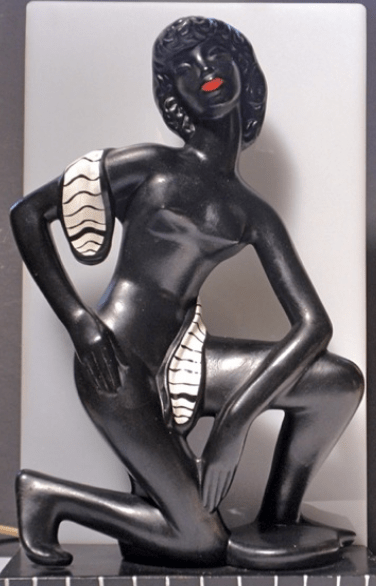
Kittys Vintage & Kitch site has some excellent insight into the Barsony brand.
There is often confusion between Duron, Nieri, Paoli and Barsony lamps. I found this website, Carter’s Publications, in Australia that has some great details on Barsony that you may be interested in. But I have tried to consolidate what I can below on Barsony in general. Full source listing below and a Barsony Product Listing here.
FULL BIOGRAPHY
Full name and aliases: George Julius Barsony, also recorded as Gyorgy Gyula Nelhibel and Gyorgy Barsony — the “Nelhibel” variant which suggests either a birth name later changed, or a Hungarian-to-German-to-Anglicised name progression (see questions below).
Born 15 November 1917 in Pecs, Baranya county, Southern Transdanubia, Hungary.
Died 7 October 2010, Casino, New South Wales (aged 92) Australia, although some sites do seem to “round it up” to 93..
Training: Pecsi Realgimnazium (Pecs Real Gymnasium) c.1930-1935, upper secondary school to 1939, then fine art training 1940-1943. He was studying at the Munich Academy of Arts in July 1944 when the school was destroyed by Allied air bombing.
Pre-migration career: Barsony was a devout Catholic and had already had real success as a religious sculptor in both Hungary and Munich before the war. His Munich commissions were lost in the bombing, but one major early work reportedly survives: a 2.2 metre bronze statue of St Francis of Assisi, and stands here – check it out!
War and emigration: refugee in Munich until 1949, arrived in Sydney in September 1949 as an assisted migrant, naturalised as an Australian citizen in 1955. Initially worked as a carpenter in Sydney out of necessity — a real comedown from his pre-war standing as a religious sculptor, worth noting for the human-interest angle of the piece.
Marriage: in 1951 he married Jean Harbutt Bird (b.1919), a British immigrant who was already working for a Sydney pottery at the time they met — meaning Jean brought direct ceramics-industry experience into the partnership, not just a supporting role. This matters: her contribution wasn’t just decorative painting (see below) but industry know-how from the outset.
THE COMPANY
Barsony Ceramics was established in 1955 at George and Jean’s own home in Bankstown, Sydney. In 1956 they built a dedicated workshop at
24 Guernsey Street, Guildford, NSW, which operated until 1970. Barsony was “highly skilled in design and mould casting,” per DAAO — he had prior professional skills in maquette-making for sculpture and in kiln construction and firing, which is why the couple were able to set up a functioning ceramics business quickly despite neither having run one before. This was part of a broader pattern: post-war Australia actively encouraged artistic immigrants to open small craft businesses, and studio pottery was a viable livelihood given rising demand for home decor — useful context for why so many similar migrant-founded decorative ceramics firms appear in this period (a parallel worth drawing to the Löhnbergs and Melani’s distributors, all doing broadly the same thing in different countries at the same historical moment).
Early products (1955-56) were small ashtrays and similar decor items. For the 1956 Melbourne Olympics tourist market, Barsony produced a series of Australian Aboriginal head wall plaques — a specific, dateable product line predating the black lady lamps that made the company famous. Black-painted figural lamps then became the dominant product line.
Range: wall plaques, candlesticks, figurines, lamp bases, bookends, vases, bowls, ashtrays.
Subjects: primarily stylised Black, Hawaiian and other “exotic” female figures, but also ballerinas, flamenco dancers, modern bathing beauties, and tennis players. Many pieces carried pearl-drop brass earrings and red-painted lips as a signature detail.
Two additional trading names: Silver Cloud and Venice. Per an independent collector source, “Silver Cloud” was named after a horse belonging to Jean Barsony’s sister. Items under these two labels are rare on the market compared to the main Barsony line.
Division of labour: Jean was responsible for much of the hand-painting, though other staff also sprayed and painted product during peak periods — the company had multiple employees and ran shifts to meet demand at its height, i.e. this was a proper small manufacturing operation, not a two-person cottage craft. A distinctive design signature: the plastic ribbon lampshades, made by cutting up rolled shower-curtain plastic into multicoloured strips.
Commercial reach: George also made plaster advertising plaques for firms including Tintara Wines, Casben Shorts, and Stamina Quality Clothes, marketed through a company run by a Mrs Mary Hodern called Plasto. Retail customers included David Jones (a major Australian department store). Barsony Ceramics itself had no retail outlet — a wholesaler called David Lyn bought job lots and handled distribution, which extended to New Zealand and the Pacific (including Vanuatu, where lamps were reportedly sold to households without electricity — purely decorative, non-functional use in that market, an interesting footnote).
Decline: 1970s tariff removals let mass-produced Japanese ceramics into the market, undercutting local producers, compounding a broader shift away from the “black lady” decorative style as taste moved on. The kiln/ceramics operation closed in 1970. Notably, lampshade-making alone continued much longer — George and Jean, and later their son Roger, kept making shades until 2005. This is a genuinely new and important correction: the “company” in some sense outlived the ceramics by 35 years, just in a narrower form. Some of George’s master moulds were sold on to Austral Pottery in Castle Hill; others were destroyed. One other later commission is documented: a mosaic for St Margaret Mary’s Catholic Church, Marylands Road, in 1967 — his only known sculpture commission of the Australian period outside the ceramics business itself.
SOURCES / REFERENCES
A huge shout out to a large number of sites I have been looking at to pull this summary together. If anyone below is not happy with what I list abovem please do get in touch so I can rectify!
Primary biographical source :
Design and Art Australia Online (DAAO), “George Barsony” biographical record: https://www.daao.org.au/bio/george-julius-barsony/
DAAO, personal details page (birth/death dates, training, residence): https://www.daao.org.au/bio/george-julius-barsony/personal_details/
DAAO, biography (prose, 667 words, written 2021, updated 2022, author “newtog”): https://www.daao.org.au/bio/george-julius-barsony/biography/
DAAO, associates page (confirms Jean Barsony nee Bird, b.1919): https://www.daao.org.au/bio/george-julius-barsony/people/
KittysVintageKitsch blog, “Know Your Collectables – Barsony Part 2” (identification guide, sticker dating, imitators):
http://kittysvintagekitsch.blogspot.com/2011/03/know-your-collectables-barsony-part-2.html
HowRetro.com, “1950s Black Lady Lamps” (short biographical piece, consistent with DAAO on core facts):
http://www.howretro.com/2011/07/1950s-black-lady-lamps.html
“Australia Barsony Ceramics” blog (2008 sale-price records for FL-27, FL-31, FL-34, FL-47): http://australiabarsonylamp.blogspot.com/2008/11/
(this is also the source for the “Silver Cloud” horse-name detail)
Lawsons (Australian auction house), FL-38 “Volcano Lady Lamp” lot listing (attributes piece directly to George Barsony by name,
1917-2010): https://www.lawsons.com.au/auction-lot/george-barsony-australia-1917-2010-fl-38-volca_34A4EA5823